von Thimo Hofner
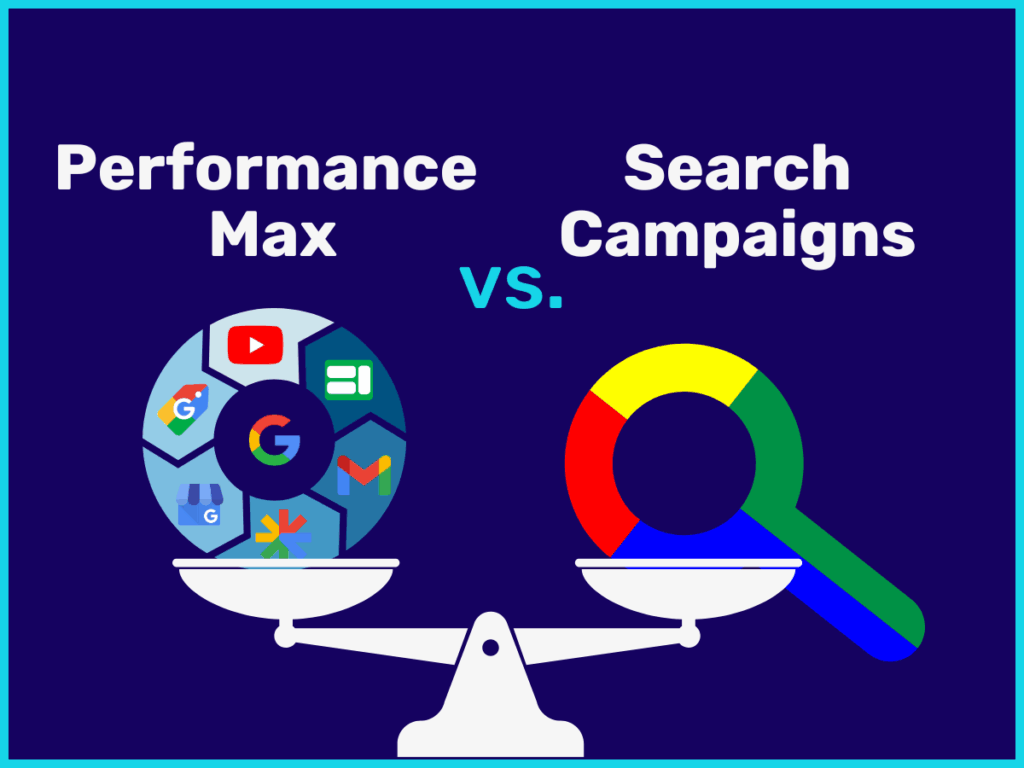
Search campaign or Performance Max (PMax): two paths, one goal. In this post, you will learn in compact form how both campaign types work, how they really differ and what AI Max changes for Search. You will also see how Search and PMax work together in parallel.
Search campaigns only run in Google Search, offer a high level of control over keywords and bids and can still be run very automatically with Broad Match, Smart Bidding and AI Max.
Performance Max relies entirely on AI and automation, combines your assets across all Google channels (Search, Shopping, YouTube, Display, Gmail, Discover) and continuously adjusts bids and playout to the expected performance.
Ideally, both work in parallel: Search provides precise data and control, PMax builds on this and generates additional revenue from users that you cannot reach with Search alone.
Of course, I’ll go into more detail in the post and you’ll find everything you need to know. Here is an overview:
Search campaigns are the classic Google Ads. Your ads are text-based and appear in the Google search results as you see them yourself when you search. In the pay-per-click model, you only pay when someone clicks on your ad.
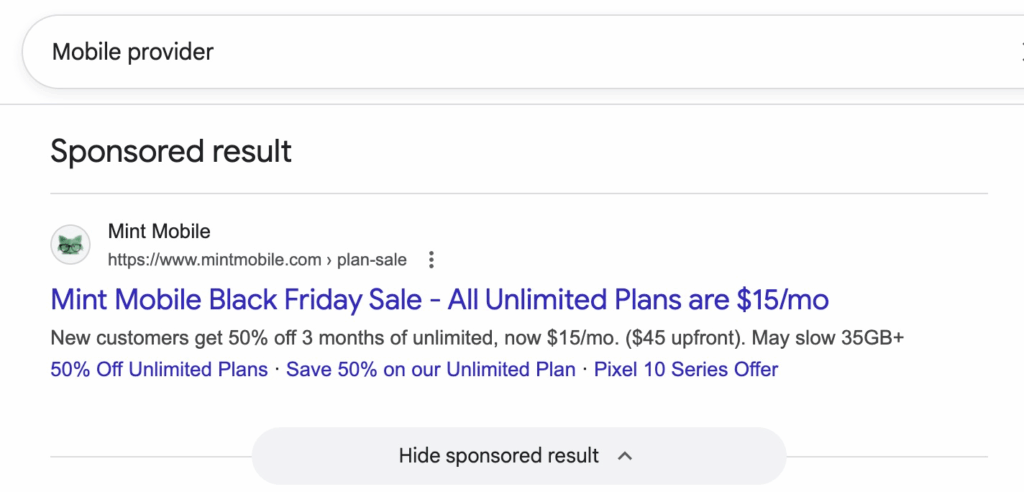
Search ads pick people up at the exact moment they are actively searching for a topic, product or provider. This makes the contacts very valuable because the intention is already there. The better your offer matches the search query, the greater the chance of a conversion.
A campaign controls budget, goal and targeting. Below this are ad groups that contain thematically neatly bundled keywords and the corresponding Responsive Search Ads.
The ad itself consists of several headlines, descriptions, a visible URL and optional extensions such as sitelinks or call extensions. Google determines which ad is shown in an auction. The decisive factor is the ad rank, i.e. the combination of bid, relevance of the ad text, expected click-through rate and user experience on the target page.
Keywords are the terms you use to control the search queries for which your ads appear.
And the match types (keyword options) determine how closely a search query must match your keyword – from exact (exact match) to broad (broad match).
Important: Match types no longer work literally, but Google checks the meaning behind the words. This is relevant as search queries are also becoming longer and longer due to the advent of AI.
More on this here: Match types in Google Ads
There are many bidding strategies available to you for search campaigns.
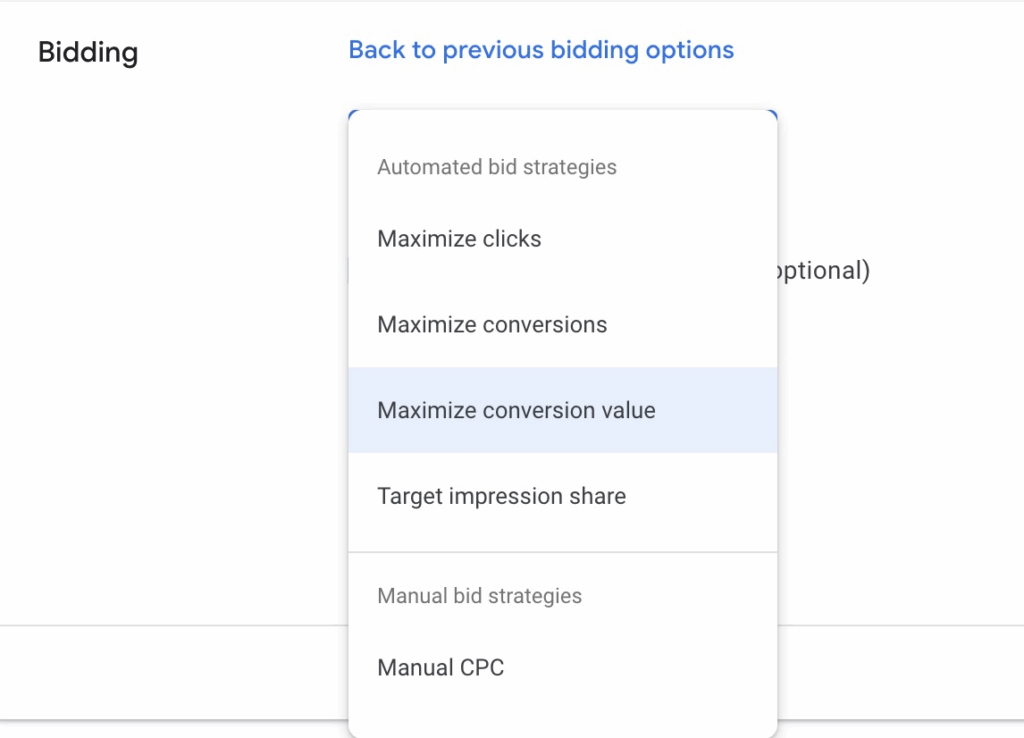
With a manual CPC, target impression share and maximize clicks, you can directly control how much you want to spend per click. Optionally, you can set a maximum CPC to secure upper limits. This gives you control over visibility and traffic, especially when budgets are tight.
The automated smart bidding strategies Maximize Conversions and Maximize Conversion Value are geared towards the end result. Optionally, they work with target CPA or target ROAS. The Google algorithm itself determines the specific CPC bids in each auction and prioritizes where the probability of success is highest.
You can also work with portfolio bidding strategies and split budgets. Portfolios bundle several campaigns under a common logic and share learning data, which increases stability and efficiency. Shared budgets distribute the daily budget dynamically across these campaigns so that the overall mix performs, not just individual silos.
With search campaigns, you can work in a very controlled manner, e.g. with exact matching keywords and manual CPC. This allows you to control which search queries should trigger ads and how much you are willing to pay. This can be narrowed down even further with negative keywords.
You can also limit the target group using audience segments.
You can also set up search in a very automated way. Broad Match in combination with Smart Bidding takes over the bidding in every auction and scales reach in a data-driven way.
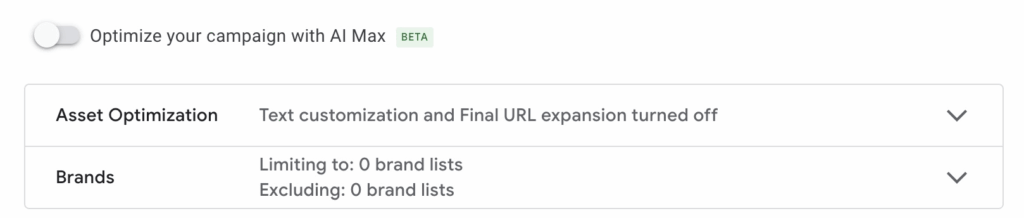
With AI Max, another automation feature has now been added.
AI Max adds additional AI support to your search campaigns.
The AI is designed to cover more thematically relevant search queries, dynamically adapt ad texts and send users to more suitable landing pages so that ads appear more “relevant”. In addition, your ads should remain visible in the new AI mode of Google Search without you needing a new campaign type. In practice, however, this also means: more automation, a little less predictability – and you have to keep a close eye on whether the additional playouts really do bring the desired conversions.
Advantages
Highly targeted traffic with clear search intent
High transparency and clean evaluation at keyword level
Offers manual control and automation
Disadvantages
Often high CPCs in competitive markets
More manual effort: structure, negatives, tests
Depending on the existing search volume
Difficulties with new products or complicated offers that have not yet been searched for
Performance Max is the highly automated multi-channel campaign type in Google Ads. With a single campaign, you can reach users in search, on the display network, on YouTube, in Gmail, in Discover and in Shopping inventory. You usually pay per click.
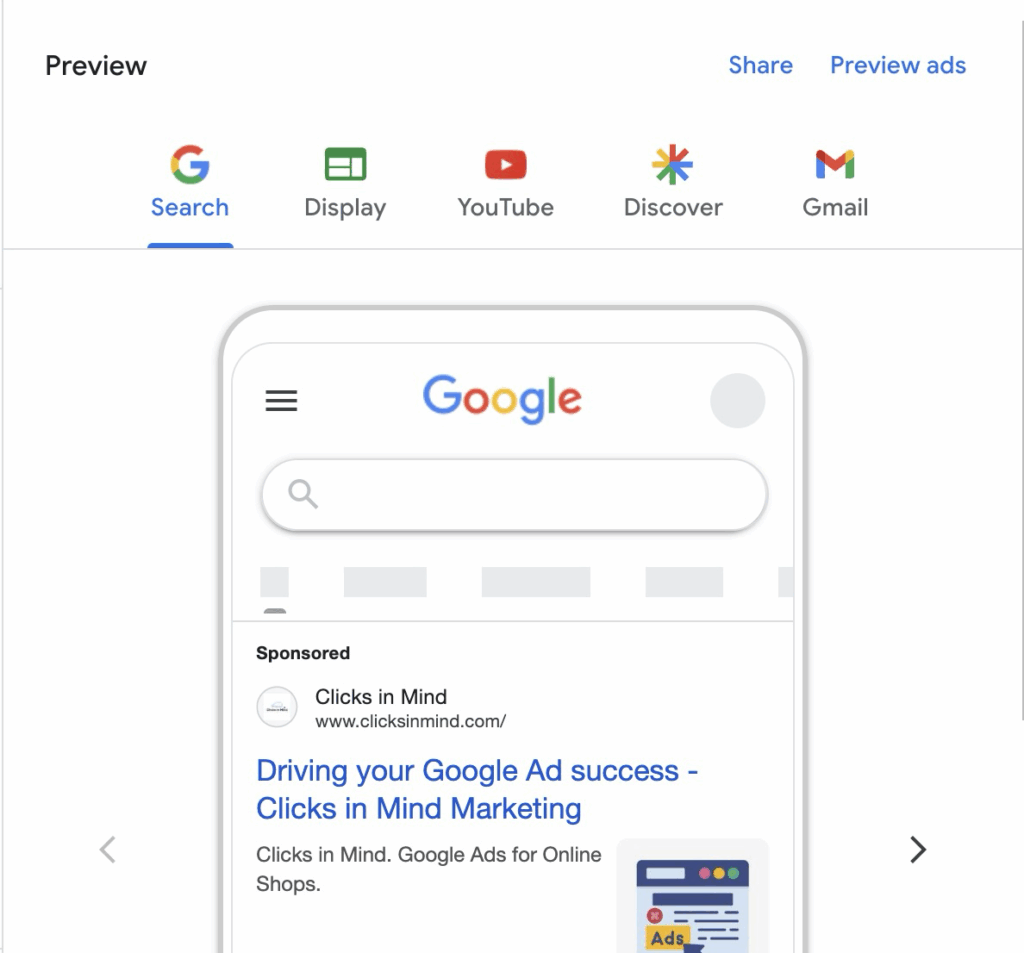
The idea behind it is simple: you provide good assets and a clear goal, Google takes care of cross-channel targeting. PMax automatically combines your advertising media into suitable formats, tests variants and shifts budget to where the probability of valuable conversions is highest.
PMax campaigns automate the entire ad placement and optimization process. Basically, you define what you want to achieve with the campaign (e.g. sales or contact requests) and the Google algorithm will optimize the campaign and ads to achieve this goal in the best possible way.
You provide texts, images, videos and ideally a product feed. When targeting, you only provide signals: target groups (e.g. remarketing, in-market, your own customer data) and search themes (keyword suggestions) as a thematic direction. Google uses these signals, but can go beyond this and find suitable users and search queries itself.
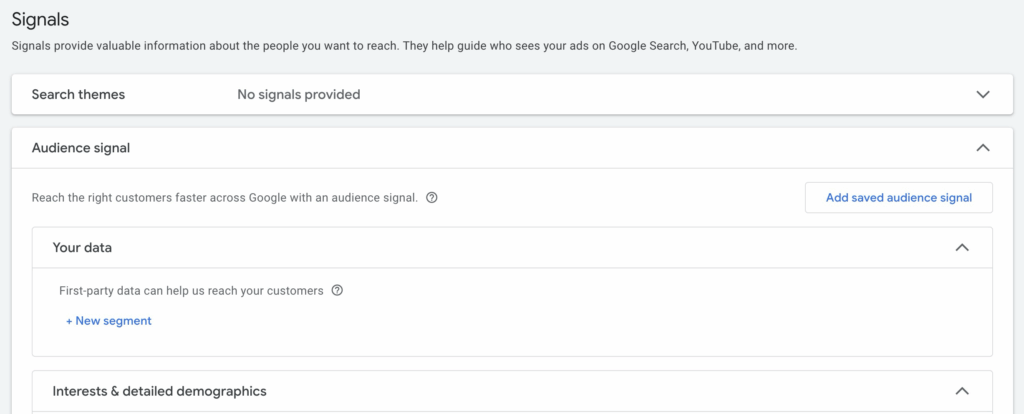
The campaign also automatically activates remarketing campaigns if the necessary target group segments are available.
You define the budget and target at the top. Below this, you work with asset groups that match a topic, product range or use case. Listing groups are added for stores to filter products. The AI combines assets according to channel, tests variants and allocates budget to where the expected value is highest.
PMax only offers Smart Bidding: Maximize Conversions (optionally with target CPA) and Maximize Conversion Value (optionally with target ROAS). Manual CPC, Target Impression Share or Maximize Clicks are not available.
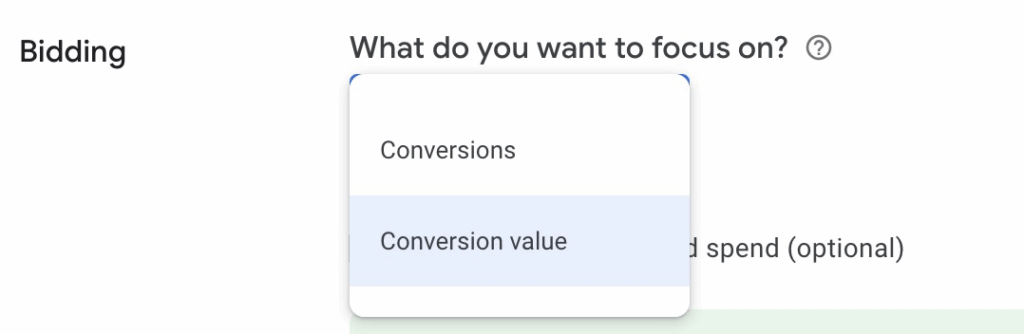
As a result, success depends heavily on your conversion tracking, as you control which success signals the AI receives from you.
Portfolio bidding strategies and split budgets are not available. Budget and target are managed directly at campaign level.
PMax was a black box for a long time, but is gradually becoming more transparent. Today, you can set negative keywords at campaign level, exclude brands and work with URL control. You can now also see in Google how the performance on the individual channels behaves in a PMax campaign.
Nevertheless, the control remains less granular than in search campaigns. You cannot weight individual channels or precisely specify placements. Many decisions are made automatically by the AI and reports remain more aggregated.
Advantages
Large reach
Combines the functions of 7 different campaign types. This allows you to advertise across the entire Google network with just one campaign.
Automatic optimization
This campaign type benefits the most from Google’s AI. The more data is collected, the better the campaign is automatically optimized. This can lead to extremely good results.
Complete marketing funnel in one campaign
Thanks to automation, this one campaign type can cover the entire customer journey from the first contact with your company through to retargeting. This happens automatically.
Less effort
The high degree of automation results in less administrative effort. It’s not about optimizing every little detail. Rather, you set the strategy and support the Google algorithm with good data and content.
High priority on the part of Google
Google prefers PMax campaigns to Shopping campaigns. In the Google universe, it is repeatedly recommended to use this type of campaign.
Disadvantages
Less control
A lot of automation means less control. You can only influence which target groups are addressed or which keywords are bid on to a very limited extent. You also have no real control over how your budget is used.
Low transparency
Compared to other campaign types, the data provided by Google is not as detailed. Performance Max is therefore often referred to as a black box – even if it is getting better.
Not good for smaller budgets
Since PMax requires a lot of data to work well, this campaign type is not well suited for small budgets.
Spam leads
Without proper conversion tracking and quality filters, PMax can generate a lot of spam leads in lead generation.
Ultimately, the question “Search or PMax (or both)?” boils down to two different approaches:
Search campaigns play exclusively on Google Search and give you a high degree of control over keywords, bids and targeting.
Performance Max, on the other hand, aims to get the maximum performance out of your budget – regardless of whether the click comes via Search, Shopping, YouTube, Display, Gmail or Discover. PMax can therefore also appear in search, but only uses this as one of several channels and controls everything via smart bidding and signals instead of classic keywords.
PMax is often used more as an amplifier for offers and target groups that already work well via search. Search campaigns pick up users with a clear search intention in a very targeted way.
Based on these signals, Performance Max can also collect additional conversions via other channels – provided there is enough data available in the account.
With a smaller budget or in a new account, I would almost always start with more manual campaign types such as search.
You only pay for users who actively search, you can see exactly which terms work and you can consistently sort out irrelevant queries. This way you get to know your market without the algorithm optimizing “into the blue”.
In my opinion, PMax is not a good entry-level campaign because it runs entirely on smart bidding and requires a stable data basis. If there are hardly any conversions, Google can only guess where bids are placed – this quickly leads to scattering and expensive tests.
As a rough rule of thumb: unless you have at least 20 to 30 real conversions per month in your account, preferably around 50, I wouldn’t use PMax as your main campaign. During this time, you will do much better with a properly set up search campaign. PMax only comes into play once this foundation has been laid and you have collected enough data.
PMax can make sense earlier in e-commerce because shopping ads are integrated and often deliver the best conversion rate.
If your product feed is clean and you already have a certain conversion volume, PMax can reinforce your existing successes and collect additional sales via Shopping, YouTube and Display.
But you don’t have to start with PMax right away. A very solid option is:
Search campaigns for brand and important generic keywords
classic shopping campaigns to get started (more about the comparison PMax vs. standard shopping)
PMax as the next step as soon as the feed, tracking and creatives are in place and the account collects enough conversions.
For lead generation, especially in B2B, I would definitely start with search.
You need control over search terms, ads, forms and landing pages so that you can control the lead quality. PMax is often criticized here for generating lots of low-quality leads if the setup is not right.
Important: If you want to use PMax for lead generation, you should definitely clean up your conversion tracking beforehand.
Only genuine success signals should count as conversions, for example qualified leads, CRM status or imported offline conversions. The better the signals, the lower the risk of PMax flooding your form with spam or irrelevant leads. Without this basis, PMax is more of a risk than a lever in the lead area.
In practice, it’s rarely an either-or situation. In most accounts, search campaigns and PMax run in parallel. The exciting question is therefore not so much “Which campaign is better?”, but rather: How do both campaign types divide search queries and roles sensibly?
Important to understand: For identical search queries with an exact match keyword in a search campaign, Search usually takes precedence. If there is no matching exact keyword, the ad rank in the auction determines whether the impression runs via Search or PMax. It is therefore normal for both campaign types to share search traffic.
A sensible strategy is to consciously design these roles:
With enough data, you can separate the roles even further. PMax can then focus more on the warmest target groups, for example via shopping, remarketing and users who have already had contact with your brand. Search campaigns can be targeted at search queries that are not yet clearly transactional, such as information or comparison terms, and target them with suitable content.
This creates an interplay: Search covers the search query in a controlled manner, PMax reinforces the existing potential and collects additional conversions via other channels – instead of simply duplicating Search.
Yes, PMax can also be used in Google Search, in addition to Display, YouTube, Gmail, Discover, and Shopping.
The important point is that you cannot directly control how the budget is divided between these channels. PMax uses performance signals to decide whether, for example, Shopping, Search, or YouTube should be prioritized. If you want to control search playout very precisely, you will still need your own search campaigns.
Yes, that is possible. PMax and search campaigns can generally bid on the same search queries because PMax also uses search inventory. In many cases, this is not a problem, but it can lead to more budget being spent via PMax and less via your clean search structure.
Important to know: If there is a matching exact match keyword in a search campaign, the search ad is usually delivered preferentially. Therefore, it is worth securing the most important terms in Search as exact matches.
Brand exclusions and negative keywords are crucial for this in PMax. With brand exclusions, you can prevent PMax from displaying brand-related search queries, so that brand traffic runs in a controlled manner via your search campaigns (if desired).
More on this here: Exclude brand keywords from PMax campaigns
There is no hard threshold, but as a guideline, you should expect at least 20 to 30 genuine conversions per month, preferably closer to 50. Below this, PMax usually lacks the data basis, smart bidding has to try too many things, and the results quickly become expensive and unstable. In this area, you will usually fare much better with a well-structured search campaign and only use PMax once this basis is in place.
Neither search campaigns nor Performance Max are “the better” type of campaign. They are two different tools designed to help you achieve your business goals. The decisive factor is not the campaign type, but how you use it: Search for control and clarity in search, PMax for additional performance across multiple channels – most powerful in combination.
I hope I was able to help you with this post and wish you every success with your campaigns. Feel free to contact me if you have any questions.
Work smart with Clicks in Mind

Hi, my name is Thimo Hofner. I have been working in online marketing as a Google Ads Manager for more than 5 years. Through many courses, trainings and most importantly working with many different clients, I have learned the best strategies for success with Google Ads. On my blog and YouTube, I share my knowledge to help you drive more success with online marketing.

Driving Your Success Through Smart Online Marketing.
As a reliable partner, I can help your company generate more customers and sales with Google Ads. After more than 5 years as a Google Ads Manager and more than $1.2 million in managed advertising budgets, I can quickly recognize where you need to make adjustments to get more out of your budget.


© 2026 Clicks in Mind